

Package Overview
This historical tour of Dhaka offers a captivating journey through centuries of architectural evolution and cultural resilience, spanning from the 12th-century origins of the Dhakeshwari Temple to the modern geometric grandeur of Louis Kahn’s National Parliament House. Travelers will explore the remnants of the Mughal Empire at the atmospheric Lalbagh Fort and the Star Mosque, witness the colonial-era elegance of Ahsan Manzil and Curzon Hall, and pay their respects at the Shaheed Minar, a profound monument to the Language Movement that shaped the nation's identity. From the banks of the Buriganga River to the heart of the university district, this curated experience blends the spiritual heritage of Shakti Peethas with the political legacy of the Nawabs, providing a comprehensive and moving portrait of Bangladesh's vibrant capital.
Photo Gallery
Detailed Itinerary
Dhakeshwari Temple
Founded in the 12th century by King Ballal Sen, this temple is the historic center of the Hindu faith in Dhaka and is often cited as the source of the city’s name. While its original architectural features have been obscured by centuries of renovations and damage during the 1971 War, it remains a vital cultural landmark and is revered by many as one of the sacred Shakti Peethas.
Ahsan Manzil
Known as the "Pink Palace," this grand Indo-Saracenic structure served as the official seat of the Nawabs of Dhaka and the site where the All India Muslim League was founded. Situated on the banks of the Buriganga River, the former residence has survived tornadoes and earthquakes to become a prominent national museum showcasing the city's aristocratic history.
Lalbagh Fort
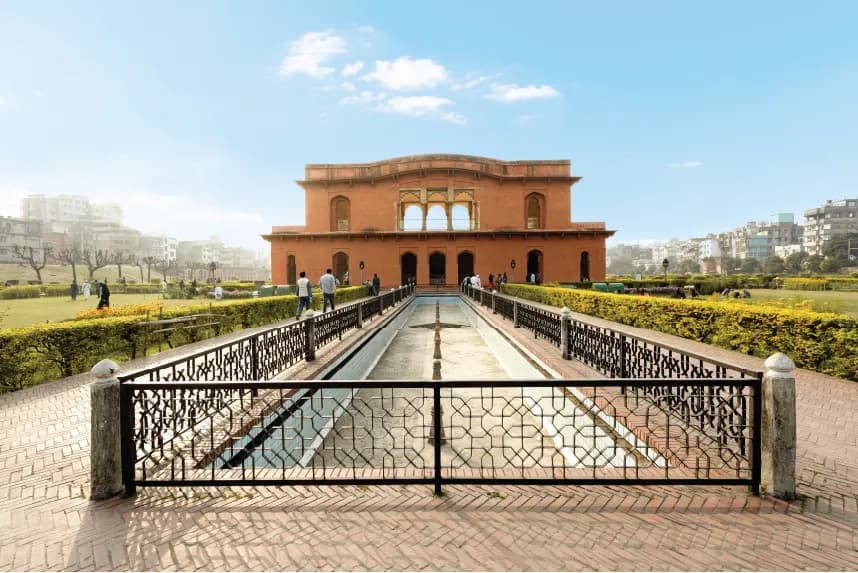
This 17th-century Mughal palace fortress, though never fully completed, stands as a masterpiece of Dhaka’s imperial past. The complex features the elegant tomb of Bibi Pari, a three-domed mosque, and a Diwan-i-Aam, all surrounded by intricate water channels, terracotta pipelines, and lush rooftop gardens that reflect the sophisticated engineering of the Mughal era.
Shaheed Minar
This solemn monument commemorates the activists killed during the 1952 Language Movement, a pivotal moment in history that eventually led to the independence of Bangladesh. Designed by sculptor Hamidur Rahman, the current structure is a reconstruction of the original, serving as the heart of national pride and the center of cultural activities every February 21st.
Parliament House
A modern architectural marvel designed by the world-renowned Louis I. Kahn, this massive complex is one of the largest legislative buildings in the world. Completed in 1982, it is celebrated for its use of geometric shapes, natural light, and surrounding lake, symbolizing a bold blend of modernism and the spirit of the Bangladeshi people.
Curzon Hall
Named after Lord Curzon and built in 1904, this striking red-brick building was originally intended to be a town hall but transitioned into an academic hub for Dhaka University. Its architecture is a beautiful fusion of European and Mughal styles, featuring spacious halls and arched verandahs set within a meticulously maintained campus garden.
Star Mosque
Renowned for its striking "Chinitikri" mosaic work, this late 18th-century mosque is adorned with thousands of pieces of broken glazed tiles and Japanese porcelain. Its interior and exterior are famous for their intricate floral patterns and the signature star motifs that give the mosque its name, making it one of the most visually unique religious sites in Old Dhaka.
Package Inclusions
Photography Included
Hotel Pickup & Drop-off
Transport: Private AC Van with a dedicated driver.
Guide: Professional English-Speaking Tour Guide throughout the trip. Other languages are available
Fees: All entrance fees, camera permissions, and taxes.